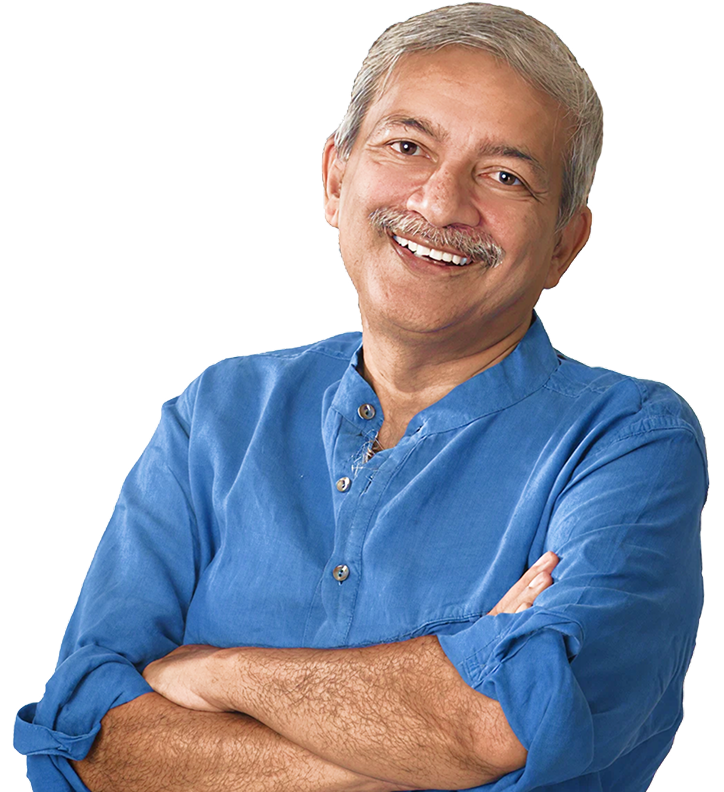
The story of rural transformation in India — at least the version told in this book — does not begin in a village. It begins in cities, in institutions, in systems, and in the mind of one man who spent decades trying to understand why large-scale change is so difficult to achieve.
Mayank Gandhi did not begin his career as an agricultural reformer. He began as a planner.
Trained as an international urban planner, he worked within systems designed to manage complexity: cities, infrastructure, governance networks, and institutional design. His early career was shaped by an interest not only in development outcomes but in development mechanisms — how systems function, how they fail, and how they can be redesigned.
Even at that stage, his thinking centered on three interrelated principles: knowledge validation, conflict resolution, and deep interconnectedness. These were not abstract ideas for him. They were practical tools for managing human systems. Development, in his view, was never about isolated interventions. It was about alignment.
Over time, however, a deeper question began to emerge: why do systems that appear rational on paper fail to produce justice in practice?
From Governance Reform to Disillusionment
In India, Mayank Gandhi's work expanded beyond planning into governance reform and public systems transformation. He became closely associated with pro-poor institutional reforms, including the Right to Information movement and decentralization efforts aimed at empowering citizens within democratic systems.
Later, he joined the India Against Corruption movement and became a founding member of the Aam Aadmi Party, drawn by the possibility of systemic ethical reform in governance.
For a time, politics appeared to offer a pathway toward structural change.
But over time, he grew disillusioned. The machinery of politics, he concluded, often rewards compromise over coherence. Policy cycles are short; incentives are fragmented; institutional inertia is deep. Even well-designed reforms can stall under competing pressures.
Most importantly, he came to believe that governance reform alone could not solve poverty.
Durable transformation, he concluded, requires economic strength at the grassroots.
This realization marked a turning point in his life and in the trajectory of his work.
The Shift Toward Ground Reality
Leaving formal politics did not diminish Mayank Gandhi's commitment to systemic change. It redirected it.
If durable transformation required economic strength, then the question became: where must one begin?
The answer lay in rural India.
Across large parts of the country, villages remained trapped in low-productivity, low-income cycles despite decades of policy attention. Economic growth in urban India had accelerated, but rural incomes lagged. Migration intensified. Ecological stress deepened. Farmer distress remained acute.
Few regions reflected this crisis more starkly than Marathwada in Maharashtra.
Marathwada: A Landscape of Crisis
Marathwada had become synonymous with agricultural distress. Repeated droughts, declining groundwater levels, volatile markets, and rising debt burdens had created a fragile rural economy. Farmer suicides drew national attention, but statistics alone could not capture the depth of despair across villages.
For Mayank Gandhi, the turning point was not a single event but a series of encounters.
He saw firsthand how systemic constraints operated together:
- water scarcity limiting crop choice
- monocropping reducing soil resilience
- market volatility eroding earnings
- debt cycles trapping families
- social stress fracturing communities
These were not isolated problems. They were interconnected.
The challenge, he realized, was not simply to support farmers but to redesign the system within which they farmed.
The Question That Changed Everything
One of the earliest insights that emerged from this period was deceptively simple:
Why focus on yield per acre when the real question is income per acre?
For decades, agricultural policy had emphasized productivity. But farmers in Marathwada were often producing more without earning more. Input costs rose faster than crop prices. Monocropping increased risk exposure. Debt accumulated even in average rainfall years.
The development conversation, he concluded, had been asking the wrong question.
The shift from yield to income became the intellectual cornerstone of what would later become the Global Vikas Trust model.
Founding Global Vikas Trust
In 2017, Mayank Gandhi founded Global Vikas Trust with a clear objective: create a scalable proof of concept for rural prosperity grounded in systemic design.
The initial focus was narrow by necessity. Rather than attempt nationwide reform, the organization concentrated on one of the most distressed regions in India: Parli taluka in Beed district, within Marathwada.
The approach was deliberate. Transformation would begin with a pilot. The pilot would be studied. The model would evolve. Only then would scale follow.
This sequencing reflected Gandhi's planning background: systemic change must be tested before it is expanded.
Water First: Rebuilding the Foundation
The first intervention was not seeds, credit, or training. It was water.
Without water security, every other intervention would remain fragile. Crop diversification would fail. Risk would remain high. Farmer confidence would remain low.
In Parli, the early water movement demonstrated what coordinated action could achieve:
- river deepening and widening
- farm ponds
- check dams
- groundwater recharge systems
Within weeks, visible transformation began. Within seasons, confidence returned. Within years, the economic landscape shifted.
Water, Gandhi would later say, is not a sectoral intervention. It is the foundation of rural prosperity.
Designing a System, Not a Program
As water security improved, the next steps followed logically.
Farmers began shifting toward high-value horticulture. Cluster-based cultivation enabled economies of scale. Training institutions emerged. Market linkages strengthened. Financial systems adapted. Social reforms took shape.
Each intervention reinforced the others.
This sequencing was intentional. Gandhi did not design a program. He designed a system.
Over time, outcomes validated the approach. Independent assessments documented significant income increases, ecological improvements, and social stabilization across participating communities.
But perhaps more importantly, the model proved replicable.
Changing Mindsets, Not Just Incomes
Economic transformation alone was not enough.
Gandhi believed deeply that poverty is also psychological and cultural. Communities shaped by decades of scarcity often internalize limits on possibility. Individual farming replaces collective planning. Risk aversion replaces innovation.
Changing this mindset became central to the work.
Villages organized collectively around social reforms:
- anti-liquor campaigns
- dowry-free marriage movements
- suicide prevention pledges
These efforts were not peripheral. They were integral. Economic progress required social cohesion and dignity.
As Gandhi often emphasized, prosperity without social reform is unstable.
From Farmer to Entrepreneur
Another transformation occurred quietly but powerfully: identity.
Farmers began to see themselves differently.
They were no longer laborers tied to uncertain seasons. They were entrepreneurs managing assets, markets, and risk. They made decisions strategically. They diversified income streams. They collaborated.
This shift in identity was as important as any infrastructure investment.
It marked the emergence of what Gandhi calls an "economics of hope."
Scaling the Vision
As results accumulated, the question of scale became unavoidable.
India has over 660,000 villages. Could a model developed in Parli scale nationally?
Gandhi's answer was cautious optimism. The model, he argued, must remain adaptable across ecological and cultural contexts. But its core principles — water security, income-centered agriculture, training, market integration, and social reform — were universal.
The goal was not replication by imitation but replication by design.
Through partnerships with governments, institutions, and civil society organizations, the model began expanding across multiple states.
A Philosophy of Urgency
Underlying Gandhi's work is a persistent sense of urgency.
He often repeats a simple phrase: India can wait no more.
For him, rural transformation is not merely a development priority. It is a national imperative. Without rising rural incomes, economic growth will remain uneven. Social tensions will rise. Migration pressures will intensify.
The stakes extend beyond agriculture.
They encompass the future of India itself.
The Economics of Hope
Mayank Gandhi's journey — from planner to reformer to rural transformation architect — reflects a broader shift in development thinking.
His work suggests that poverty is neither inevitable nor intractable. It is systemic, and systems can be redesigned.
The economics of hope he advances is not sentimental. It is grounded in evidence, discipline, and design.
It insists that prosperity is achievable not through isolated programs but through integrated systems built patiently over time.
The chapters that follow examine this system in detail — how it works, why it works, and what it offers to a world still searching for durable pathways out of poverty.